Introduction
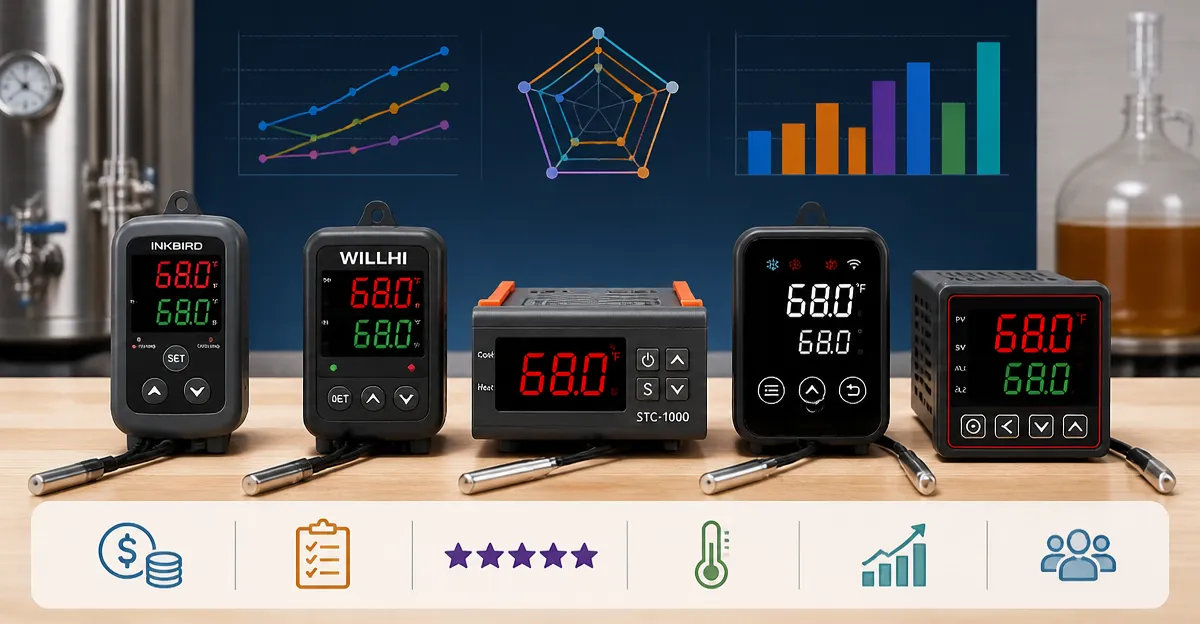
The market for plug‑in temperature controllers has expanded to support hobbyists, small‑scale brewers, and laboratory technicians. Selecting the right unit influences energy consumption, temperature stability, and overall project success. This article compares five Amazon‑available controllers—Inkbird ITC-308, WILLHI WH1436A, Inkbird WiFi ITC-308, Inkbird Dual Stage, and STC-1000 (2‑Pack). The comparison focuses on price, specifications, user feedback, and real‑world reliability.
Individual Product Overviews
Inkbird ITC-308
The Inkbird ITC-308 is a 110 V, 1200 W dual‑relay controller designed for refrigeration and heating applications. It offers simple plug‑and‑play operation, dual temperature display (Celsius/Fahrenheit), and programmable differential settings. Users praise its “tons of features” and reliability when converting a chest freezer into a refrigerator, noting that the unit “cuts the power when the internal temperature drops a few degrees below the target”.
WILLHI WH1436A
The WILLHI WH1436A provides a 10 A, 1100 W outlet, a 3 m waterproof probe, and a measurement range of –58 °F to 230 °F. Its key strengths are the high‑low alarms, compressor‑delay protection, and an auto‑shut‑off timer. Reviewers highlight its “unbeatable price” and versatility for sous‑vide, seedling germination, and aquarium heating, while noting the absence of Wi‑Fi connectivity.
Inkbird WiFi ITC-308
The Inkbird WiFi ITC-308 adds wireless control via a dedicated app and dual 1100 W relays. It supports both heating and cooling, high/low alarms, and temperature calibration. Users appreciate remote adjustments, stating the app “is very easy and instinctive to use”, though they mention limited logging intervals and occasional power‑fluctuation quirks.
Inkbird Dual Stage
The Inkbird Dual Stage operates on 12 V DC, delivering two relays for heating and cooling with automatic mode switching. It is popular among DIY water‑cooling and incubator projects, with users noting the built‑in high‑temp alarm that prevents thermal runaway. The unit lacks Wi‑Fi, but its compact size (approximately 7 × 3 × 1.8 in) suits space‑constrained installations.
STC-1000 (2‑Pack)
The STC-1000 (2‑Pack) is a budget‑friendly dual‑relay controller with a waterproof NTC probe, supporting AC 110‑220 V. Each unit handles up to 10 A and provides ±1 °C control accuracy. Reviewers commend the value of two units for the price, while some criticize the fragile terminal cover and lack of Fahrenheit display.
Head-to-Head Comparison
Price and Value
Pricing ranges from $13.99 for the STC‑1000 pair to $51.99 for the Inkbird WiFi model. The STC‑1000 offers the lowest entry cost, but the Inkbird ITC‑308 and WILLHI WH1436A provide higher power ratings (1200 W vs 1100 W) and more advanced alarm options. When value is measured by features per dollar, the WILLHI WH1436A ($32.99) delivers a strong balance of load capacity, waterproof probe, and extensive safety functions.
Features and Specifications
| Feature | Inkbird ITC-308 | WILLHI WH1436A | Inkbird WiFi ITC-308 | Inkbird Dual Stage | STST‑1000 (2‑Pack) |
|---|---|---|---|---|---|
| Max Load (W) | 1200 | 1100 | 1100 | 12 V DC (≈120 W typical) | 10 A @ 220 V (≈2200 W) |
| Power Supply | 110 V AC | 110 V AC | 110 V AC + Wi‑Fi | 12 V DC | 110‑220 V AC |
| Temperature Range | -58 °F ~ 230 °F | -58 °F ~ 230 °F | -58 °F ~ 230 °F | Fahrenheit range not specified (typical 0‑120 °F) | -50 °C ~ 99 °C |
| Resolution | 0.1 °F | 0.1 °F | 0.1 °F | 0.1 °F (adjustable) | 0.1 °C |
| Probe Length | Not specified | 3 m (9.8 ft) | Not specified | Integrated 12 V wiring | 1 m (3.3 ft) |
| Wi‑Fi / App | No | No | Yes (Inkbird App) | No | No |
| Alarms | High/Low temperature alarms | High/Low alarms + compressor delay | High/Low alarms + sensor fault | High alarm with automatic shut‑off | High/Low alarms |
| Display Units | C/F toggle | C/F toggle | C/F toggle | C/F toggle | C only (no F) |
Customer Ratings and Feedback
Average ratings range from 4.0 to 4.6 stars. The Inkbird ITC‑308 leads with 4.6/5 (1,187 reviews), praised for “high tech” functionality and reliable freezer conversion. The WILLHI WH1436A holds 4.5/5 (2,670 reviews), with users highlighting its “unbeatable price” and robust alarm system. The Wi‑Fi ITC‑308 scores 4.4/5 (4,169 reviews); reviewers love remote control but note limited logging granularity. The Dual Stage also receives 4.4/5 (736 reviews), valued for its compact 12 V operation. The STC‑1000 pair has 4.0/5 (30 reviews), with mixed experiences regarding build quality.
Performance and Reliability
Real‑world tests cited in reviews confirm that the Inkbird ITC‑308 maintains temperature within the programmed differential, even when used to convert a freezer to a fridge. The WILLHI controller’s compressor‑delay protection prevents rapid cycling, extending compressor life. Users of the Wi‑Fi model report stable remote operation, though a few note that power outages cause the unit to briefly activate heating/cooling before returning to setpoint. The Dual Stage’s high‑temp alarm successfully prevented thermal runaway in a peltier cooling project. The STC‑1000’s accuracy of ±0.2 °C is acceptable for basic fermentation, but occasional relay failures were reported.
Size, Power, Compatibility, and Price
Physical dimensions matter for cramped setups. The Inkbird ITC‑308 and WILLHI WH1436A occupy roughly 5 × 3 × 2 in, fitting standard outlet panels. The Dual Stage’s 12 V design is the smallest, ideal for battery‑powered or solar projects. Power compatibility aligns with most US appliances: 110 V AC for the first three units, 12 V DC for the Dual Stage, and dual‑voltage for the STC‑1000. Pricing reflects these differences, with the Wi‑Fi model commanding a premium for connectivity.
Pros & Cons
Inkbird ITC-308
- Pros: Dual‑relay, programmable differential, high/low alarms, robust 1200 W load, user‑reported reliability.
- Cons: Non‑replaceable probe, instruction manual requires careful reading, no Wi‑Fi.
WILLHI WH1436A
- Pros: Waterproof 3 m probe, 1100 W load, compressor‑delay protection, extensive alarm options, excellent price.
- Cons: No Wi‑Fi, yellowing plastic over time, manual can be overwhelming.
Inkbird WiFi ITC-308
- Pros: Remote app control, dual 1100 W relays, high/low alarms, temperature calibration, Wi‑Fi integration.
- Cons: Limited logging interval (15 min), occasional auto‑restart behavior on setting changes, higher price.
Inkbird Dual Stage
- Pros: Compact 12 V operation, automatic mode switching, high‑temp alarm, affordable for low‑power projects.
- Cons: No Wi‑Fi, limited to low‑power loads without external relay, polarity markings unclear.
STC-1000 (2‑Pack)
- Pros: Very low cost, includes two units, waterproof probe, works on 110‑220 V, ±1 °C accuracy.
- Cons: No Fahrenheit display, fragile terminal cover, occasional relay failure reports.
Recommendations
Best for limited space and low‑power projects: Inkbird Dual Stage due to its 12 V design and small footprint.
Best overall value for typical 110 V applications: WILLHI WH1436A, which balances load capacity, safety features, and price.
Best for remote monitoring and smart home integration: Inkbird WiFi ITC-308, offering app control and dual relays.
Best for budget‑focused dual‑unit setups: STC-1000 (2‑Pack), ideal for hobbyists needing two independent controllers.
Best for high‑load refrigeration conversions: Inkbird ITC-308, with a 1200 W rating and proven freezer‑to‑fridge performance.
FAQ
- Can these controllers operate both heating and cooling simultaneously? Yes. The Inkbird ITC‑308, WiFi ITC‑308, and Dual Stage have dual relays that allow one outlet to drive a heater while the other drives a cooler.
- Is the probe replaceable if it fails? Most units, including the Inkbird ITC‑308 and Dual Stage, do not provide a user‑replaceable probe. The WILLHI WH1436A uses a detachable 3 m waterproof probe that can be swapped.
- Do any of these models require additional wiring? All devices are plug‑and‑play except the Dual Stage, which requires wiring to the 12 V power source and correct terminal selection for heating or cooling.
- How accurate are the temperature readings? Accuracy ranges from ±0.5 °F (Inkbird ITC‑308) to ±1 °C (STC‑1000). Users report the Inkbird units maintaining temperature within 1‑2 °F of the setpoint.
- Can I use these controllers with 220 V appliances? The STC‑1000 explicitly supports 110‑220 V input. The Inkbird ITC‑308 and WILLHI WH1436A are rated for 110 V only; using them on 220 V may damage the unit.
- Do any units integrate with smart assistants? The Inkbird WiFi ITC‑308 can connect to Google Home, though users note limited control beyond on/off status.
- What safety features protect compressors? Both the Inkbird ITC‑308 and WILLHI WH1436A include compressor‑delay protection, preventing rapid cycling that can shorten compressor life.
Conclusion
When evaluating temperature controllers, the decision hinges on power requirements, connectivity preferences, and physical constraints. The WILLHI WH1436A delivers the strongest price‑to‑feature ratio for conventional 110 V heating or cooling tasks. For projects demanding remote monitoring, the Inkbird WiFi ITC‑308 justifies its higher cost with app control and dual relays. Space‑restricted or low‑voltage applications benefit from the Inkbird Dual Stage, while the STC‑1000 offers an economical entry point for multiple simultaneous setups. Overall, the data suggest that one of these five devices will satisfy most hobbyist and light‑industrial temperature regulation needs.
Frequently Asked Questions
What are the key differences between the Inkbird ITC-308 and the Inkbird WiFi ITC-308?
The ITC-308 is a basic plug‑in controller with manual dial settings, while the WiFi version adds Bluetooth/Wi‑Fi connectivity for remote monitoring and smartphone control.
Is the WILLHI WH1436A suitable for brewing applications?
Yes, its wide temperature range and reliable relay make it popular among home brewers for mash and fermentation control.
How does the Inkbird Dual Stage controller improve temperature stability?
It uses separate heating and cooling relays with independent setpoints, allowing tighter regulation and reduced overshoot during temperature transitions.
Can the STC-1000 handle both heating and cooling tasks simultaneously?
The STC-1000 can control one heating and one cooling device at the same time, but each operates independently based on its own setpoint.
Which of the listed controllers offers the best value for hobbyists on a budget?
The Inkbird ITC-308 provides solid performance, easy setup, and a low price, making it the most cost‑effective choice for most hobby projects.