
How to Measure Titratable Acidity at Home for Pickles: A DIY Step-by-Step Guide
Introduction
One will learn how to determine the titratable acidity (TA) of homemade pickles, a key indicator of flavor balance and safety. Understanding TA enables one to produce consistent sourness, prevent spoilage, and tailor recipes to personal preference. This guide explains the chemistry behind TA, presents the equipment required, and provides a clear, actionable workflow. By the end of the article, readers will be capable of measuring and adjusting acidity without laboratory equipment.
What You'll Need
- Fresh vegetables (cucumbers, carrots, or beans)
- Distilled white vinegar (5%–7% acidity)
- Granulated sugar or honey (optional for sweet pickles)
- Water (non‑chlorinated)
- Food‑grade glass jars with lids
- Digital kitchen scale
- Measuring cups and spoons
- pH meter or calibrated test strips (for reference)
- Laboratory‑grade titration kit (burette, stand, funnel)
- 0.1 N sodium hydroxide (NaOH) solution
- Phenolphthalein indicator drops
- Pickle Kit Refill (optional seasoning aid)
Step 1: Gather Ingredients and Tools
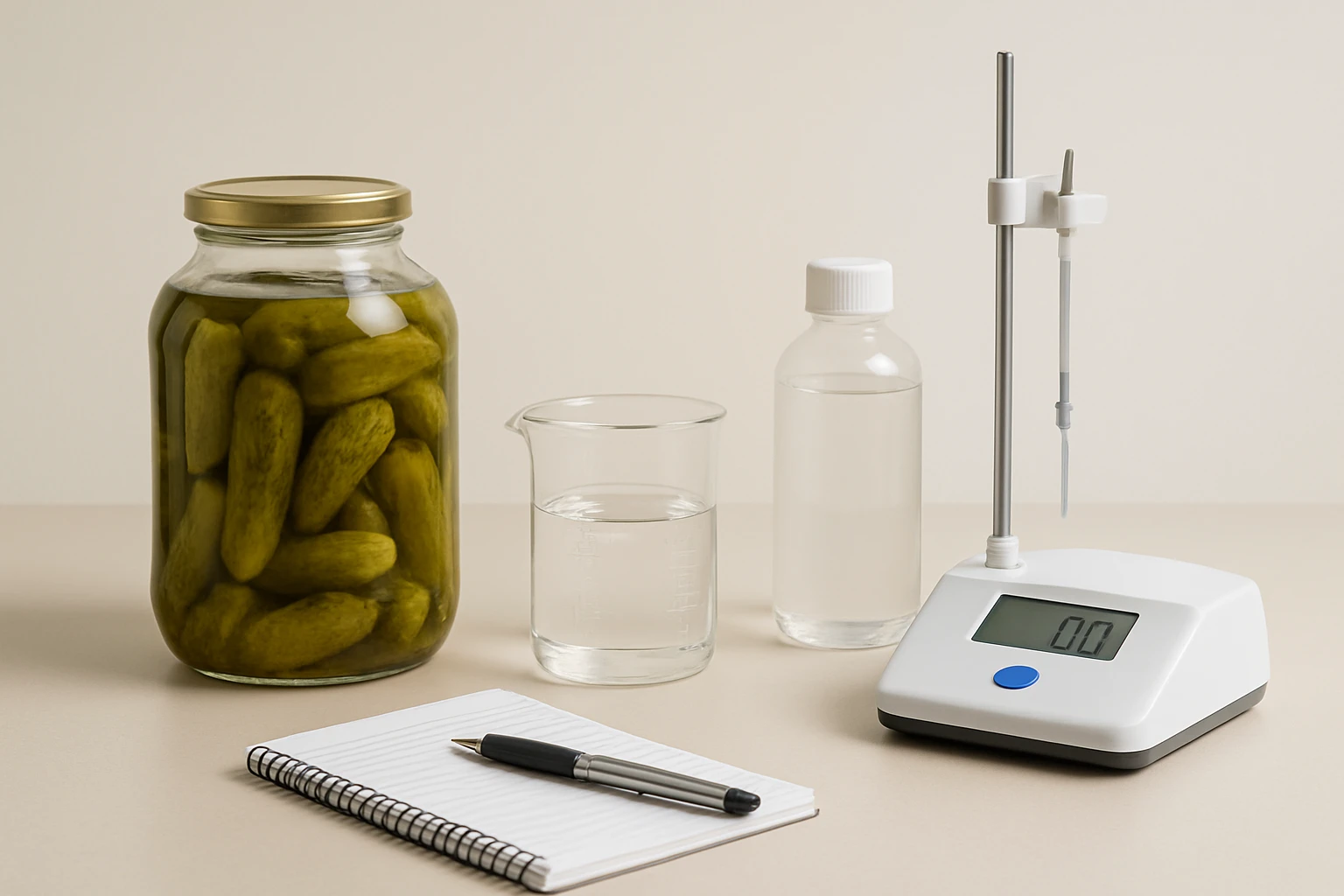
Begin by inspecting vegetables for freshness; any bruises or soft spots can introduce unwanted microbes that affect acidity. Weigh each vegetable portion using the digital kitchen scale to ensure reproducible brine ratios across batches. Assemble the titration apparatus on a stable surface, confirming that the burette is clean and free of residues that could skew results. If a pH meter is available, calibrate it with standard buffers (pH 4.0 and pH 7.0) to provide a secondary reference for the final product.
Step 2: Prepare the Brine
Combine distilled white vinegar and non‑chlorinated water in a saucepan at a 1:1 ratio; this baseline provides approximately 5% acidity, a common target for quick pickles. Heat the mixture to just below boiling, stirring in sugar or honey if a sweet profile is desired; the sugar dissolves completely, preventing crystal formation during fermentation. Allow the brine to cool to room temperature before adding vegetables, as excessive heat can damage cell walls and alter the measured TA. Record the total volume of brine prepared, as this figure will be used in the titration calculations.
Step 3: Add Vegetables and Seasoning
Place the cleaned vegetables into sterilized glass jars, leaving about one inch of headspace at the top. Pour the cooled brine over the vegetables, ensuring they are fully submerged; use a fermentation weight if necessary to keep them below the liquid surface. For consistent flavor and an organic source of herbs, one may use the Pickle Kit Refill. Each packet contains a pre‑measured organic seasoning mix that is non‑GMO, free of additives, and formulated to complement the acidity of the brine. The kit costs $7.99, carries a 4.5‑star rating from 797 reviewers, and eliminates the guesswork of measuring individual spices, thereby reducing variability in TA caused by uneven herb distribution.
Step 4: Measure Titratable Acidity
After the pickles have rested for at least 24 hours, extract a 10 mL sample of brine using a clean pipette; avoid any sediment that could interfere with the titration. Transfer the sample into a clean Erlenmeyer flask and add three drops of phenolphthalein indicator; the solution will remain colorless until the endpoint is reached. Fill the burette with 0.1 N NaOH, ensuring no air bubbles remain in the nozzle. Slowly add NaOH to the sample while swirling gently; the first permanent pink hue that persists for 30 seconds marks the endpoint.
The volume of NaOH dispensed (V_NaOH) is recorded in milliliters. Titratable acidity (as % lactic acid) is calculated using the formula:
TA (%) = (V_NaOH × N_NaOH × 0.09) / Sample Volume (mL) × 100
In this equation, 0.09 represents the equivalent weight of lactic acid (90 g/mol). For example, if 4.5 mL of 0.1 N NaOH is required, the calculation yields:
TA = (4.5 × 0.1 × 0.09) / 10 × 100 = 0.405 %
This result indicates a mild acidity suitable for quick pickles; higher values may be desired for longer fermentation or for preserving low‑acid vegetables.
Step 5: Adjust and Store
If the measured TA falls below the target range (0.5%–0.7% for most pickles), one can increase acidity by adding a measured amount of vinegar to the brine and re‑titrating. Conversely, if the TA is too high, dilute the brine with additional water and repeat the titration until the desired level is achieved. Once the optimal TA is confirmed, seal the jars tightly and store them in a cool, dark place; the measured acidity will inhibit pathogenic growth and preserve crispness. Record the final TA value on the jar label for future reference and recipe refinement.
Tips & Pro Tips
- Use a magnetic stir bar during titration to ensure uniform mixing and a sharp endpoint.
- Perform the titration at consistent room temperature (20 °C ± 2 °C) to avoid temperature‑dependent variations in NaOH concentration.
- When using the Pickle Kit Refill, dissolve the seasoning packets in a small amount of brine before adding to the full batch; this prevents clumping and ensures even distribution.
- Store the NaOH solution in a tightly sealed amber bottle to protect it from carbon dioxide absorption, which can reduce its normality over time.
- Keep a logbook of each batch, noting vegetable type, brine composition, TA, and any adjustments made; this practice accelerates mastery of the process.
Troubleshooting
Problem: The titration endpoint appears fuzzy or takes an unusually long time to develop.
Solution: Verify that the phenolphthalein indicator is fresh; degraded indicator can produce weak color changes. Also, ensure the NaOH solution has not absorbed atmospheric CO₂, which would lower its effective concentration.
Problem: Measured TA is consistently higher than expected.
Solution: Check the vinegar concentration with a separate pH test; some commercial vinegars are labeled 5% but may be slightly stronger. Adjust the water‑to‑vinegar ratio accordingly before re‑titrating.
Conclusion
One has now mastered the technique of measuring titratable acidity in homemade pickles, a skill that enhances flavor control, safety, and reproducibility. By following the outlined steps, selecting appropriate tools, and optionally using the Pickle Kit Refill for consistent seasoning, anyone can achieve professional‑grade results in a home kitchen. Continued experimentation and diligent record‑keeping will further refine one’s ability to craft pickles that meet exacting taste standards.
Products Mentioned in This Guide
Frequently Asked Questions
What is titratable acidity and why does it matter for pickles?
Titratable acidity (TA) measures the total acid concentration that contributes to sour flavor and safety, ensuring consistent taste and preventing spoilage.
Can I measure titratable acidity without a laboratory titration kit?
Yes, you can estimate TA using a calibrated pH meter or test strips, though a simple NaOH titration provides more accurate results.
How much 0.1 N NaOH do I need to neutralize a typical 500 ml jar of pickles?
Approximately 10‑12 ml of 0.1 N NaOH will neutralize the acids in a 500 ml jar, but exact volume varies with recipe acidity.
What safety precautions should I follow when handling NaOH for titration?
Wear gloves and eye protection, work in a well‑ventilated area, and add NaOH to water slowly to avoid splashing.
How can I adjust the acidity if the measured TA is too low?
Increase the amount of vinegar or add a small volume of 0.1 N NaOH to the brine, then re‑measure until the desired TA is reached.