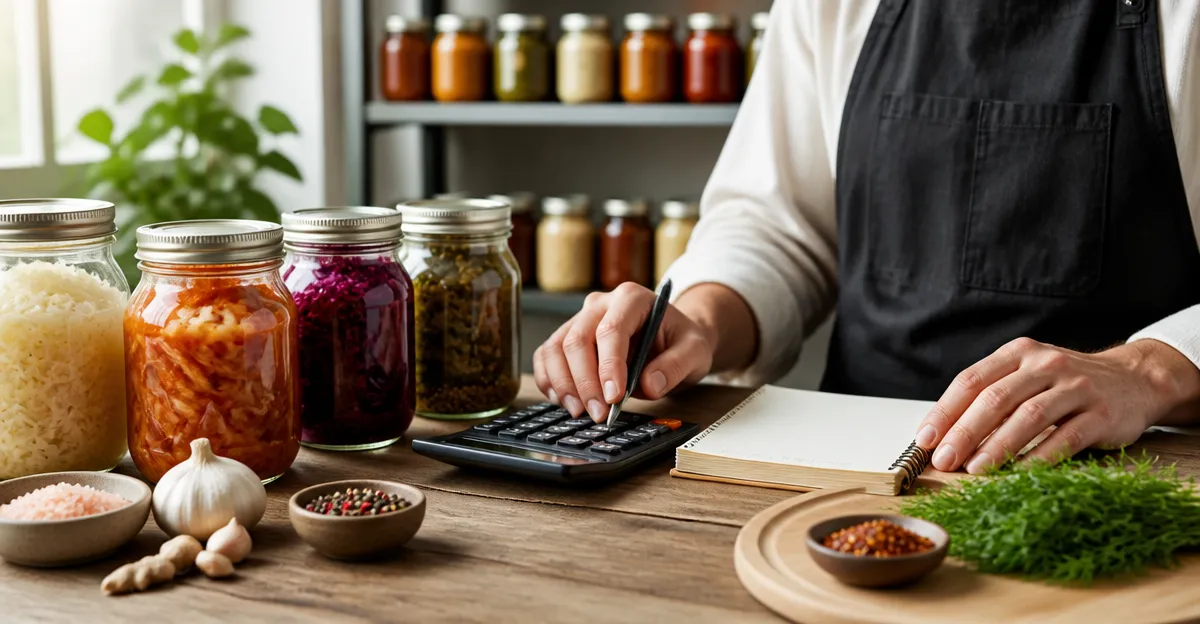
How to Price Small‑Batch Fermented Products: Step‑by‑Step Guide to Costing, Profit Margins & Competitive Pricing
Introduction
Pricing small‑batch fermented products requires a blend of culinary knowledge, financial acumen, and market awareness. This guide will explain the full pricing process, from ingredient cost calculation to final retail price, and will recommend tools that simplify each step. Readers will learn how to determine true production costs, apply appropriate profit margins, and position their products competitively while maintaining quality standards.
The guide is organized into clear sections, each focusing on a critical component of pricing strategy. Real‑world examples and product recommendations are included to illustrate how professional‑grade kitchen scales can improve accuracy and efficiency during the costing phase.
By following the step‑by‑step methodology, artisans will be able to price their kimchi, sauerkraut, kombucha, and other fermented goods with confidence, ensuring sustainable growth and customer satisfaction.
Background and Context
Fermentation transforms simple ingredients into complex flavors through microbial activity. Because the process often involves variable yields, precise measurement of raw materials is essential for accurate cost accounting. In addition, small‑batch producers typically operate with limited economies of scale, making every gram of ingredient and every minute of labor significant.
Key financial concepts underpinning pricing include direct costs (ingredients, packaging, utilities), indirect costs (rent, equipment depreciation, marketing), and desired profit margin. Understanding the interplay of these elements allows producers to set prices that cover expenses, generate profit, and remain attractive to consumers.
Accurate weighing is the foundation of cost calculation. A reliable kitchen scale ensures that ingredient usage is consistent batch‑to‑batch, reducing waste and enabling precise cost per unit estimates. The following sections recommend scales that excel in durability, precision, and ease of use.
Step 1: Calculate Ingredient Costs
The first step in pricing is to determine the cost of each ingredient per batch. Convert bulk purchase prices to a per‑gram or per‑ounce cost, then multiply by the exact weight used in the recipe. For example, if a 5 kg bag of organic cabbage costs $15, the cost per gram is $0.003. Using a scale that measures to 1 g ensures that the calculation reflects actual usage.
When measuring liquids such as brine or kombucha starter, a scale with a large platform and clear display simplifies the process. The BakFee 33 lb USB Rechargeable Kitchen Scale offers a 9 × 6.3 inch platform that accommodates large containers without obscuring the screen, and its 1 g accuracy is ideal for both solids and liquids.
Record each ingredient’s weight, cost, and total expense in a spreadsheet. Summing these values yields the total direct ingredient cost for the batch.
Remember to include ancillary items such as spices, starter cultures, and any flavor‑enhancing additives, as they can represent a significant portion of the overall cost in fermented products.
Step 2: Account for Packaging and Labeling
Packaging cost includes containers, lids, sealing films, and labels. Weigh an empty container on the scale to determine its net weight, then calculate the cost per gram based on the purchase price of the container batch. For instance, a set of 100 glass jars at $30 results in $0.30 per jar; if each jar weighs 300 g, the packaging cost per gram is $0.001.
The Escali Primo Digital Kitchen Scale provides a compact footprint and a sealed control panel that resists spills, making it convenient for weighing small jars and lids without risking damage to the device.
Include label printing costs, which are often calculated per square inch. Accurate measurement of label size and material weight helps avoid under‑ or over‑estimating this expense.
Summarize packaging and labeling costs alongside ingredient costs to obtain the total variable cost per batch.
Step 3: Factor in Labor and Overhead
Labor costs encompass preparation, fermentation monitoring, bottling, and cleaning. Estimate the total hours spent on a batch and multiply by an hourly wage rate. For example, if a batch requires 5 hours of labor at $15 per hour, labor cost equals $75.
Overhead includes rent, utilities, equipment depreciation, and insurance. Allocate a portion of these fixed costs to each batch based on production volume. A simple method is to divide monthly overhead by the number of batches produced in that month.
While labor and overhead are not measured by weight, a reliable scale can reduce time spent on re‑weighing and recalculating, indirectly lowering labor expenses.
Combine labor and overhead with variable costs to determine the total production cost per batch.
Step 4: Determine Desired Profit Margin
A profit margin expresses the percentage of revenue retained after covering all costs. Small‑batch producers often target a margin between 30 % and 50 % to sustain growth while remaining price‑competitive. To calculate the selling price, use the formula:
Selling Price = Total Cost ÷ (1 – Desired Margin)
For example, if total cost per batch is $200 and the desired margin is 40 %, the selling price equals $200 ÷ (1 – 0.40) = $333.33. Divide this amount by the number of units in the batch to obtain the unit price.
Adjust the margin based on market positioning. Premium, artisanal branding may justify a higher margin, whereas entry‑level products may require a lower margin to attract price‑sensitive customers.
Regularly review margins as ingredient prices fluctuate or as production efficiency improves.
Step 5: Conduct Competitive Pricing Analysis
Research comparable fermented products in local markets and online platforms. Note their price points, packaging sizes, and perceived quality. Use this information to benchmark your pricing, ensuring it aligns with consumer expectations.
When competitors emphasize organic certification or unique flavor profiles, consider whether your product offers similar differentiators that justify a comparable or higher price.
Incorporate findings into a pricing matrix that balances cost‑plus pricing with market‑driven adjustments.
Remember that pricing is dynamic; revisit the analysis quarterly to respond to market shifts.
Comparison and Selection Guide for Kitchen Scales
Choosing the right scale can streamline the costing process. The table below compares the four featured scales based on capacity, precision, power source, and special features.
| Scale | Capacity | Precision | Power Source | Key Feature | Rating |
|---|---|---|---|---|---|
| BakFee 33 lb USB Rechargeable Kitchen Scale | 15 kg (33 lb) | 1 g / 0.05 oz | USB rechargeable or 2 AAA batteries | Large tempered‑glass platform; splash‑resistant surface | Not provided |
| Escali Primo Digital Kitchen Scale | 5 kg (11 lb) | 1 g / 0.05 oz | 2 AAA batteries | Sealed control panel; two‑button operation | 4.7/5 (15,346 reviews) |
| AmazonBasics 11 lb Digital Kitchen Scale | 5 kg (11 lb) | 1 g / 0.05 oz | 2 AAA batteries (included) | BPA‑free plastic; wide LCD screen | 4.7/5 (116,903 reviews) |
| KitchenAid KQ913 Waterproof Kitchen Scale | 5 kg (11 lb) | 1 g / 0.05 oz | 3 AAA batteries (included) | IPX7 waterproof rating; touch‑capacitive buttons | Not provided |
For high‑volume producers who frequently weigh large containers, the BakFee model offers the greatest capacity and a durable surface that resists spills. Small‑space kitchens may prefer the compact Escali Primo, which combines a sealed panel with reliable accuracy. Budget‑conscious artisans can achieve satisfactory performance with the AmazonBasics scale, while the KitchenAid waterproof option excels in environments where frequent cleaning is required.
Best Practices & Tips
- Standardize measurement units across all calculations to avoid conversion errors.
- Calibrate the scale regularly according to the manufacturer’s instructions to maintain precision.
- Document each batch’s cost breakdown in a dedicated template; this creates a historical record for future pricing adjustments.
- Include a small contingency factor (e.g., 2‑3 %) to cover unexpected ingredient price fluctuations.
- Leverage seasonal ingredient sales to reduce raw material costs and improve profit margins.
- Offer tiered pricing for bulk orders, which can increase overall revenue while rewarding larger customers.
Frequently Asked Questions
- How often should I recalibrate my kitchen scale? It is advisable to recalibrate the scale monthly or whenever it is moved to a new location, as temperature and surface variations can affect accuracy.
- What is a reasonable profit margin for artisanal fermented foods? Margins between 30 % and 50 % are common, but the exact figure depends on brand positioning, production efficiency, and target market.
- Can I use a kitchen scale for both solid and liquid ingredients? Yes; scales with a splash‑resistant surface, such as the BakFee model, handle liquids effectively. Use a container on the platform and tare to zero out its weight.
- How do I account for fermentation loss in pricing? Measure the weight of the product before and after fermentation; subtract the loss from the final weight and distribute the cost of the lost mass across the remaining product.
- Is it necessary to include packaging waste in cost calculations? Absolutely; packaging waste contributes to material costs and can affect sustainability claims, which influence consumer perception.
- What if my competitor’s price is lower? Evaluate whether their product offers comparable quality, certifications, or flavor complexity. If not, emphasize your unique value proposition rather than matching price.
- Do I need to charge sales tax on online sales? Sales tax obligations vary by jurisdiction; consult local regulations or a tax professional to ensure compliance.
Conclusion
Pricing small‑batch fermented products is a systematic process that blends accurate cost measurement, thoughtful margin selection, and market awareness. By employing precise weighing tools, such as the scales highlighted in this guide, producers can eliminate guesswork, reduce waste, and present transparent pricing to consumers. Consistent documentation, periodic margin reviews, and strategic competitive analysis will support sustainable growth and brand credibility.
Implement the step‑by‑step framework presented herein, adapt it to your unique production workflow, and watch your fermented creations thrive in the marketplace.
Products Featured in This Guide
BakFee 33 lb USB Rechargeable Kitchen Scale
Price: Not listed | Rating: Not listed
Featured for its large 9 × 6.3 inch tempered‑glass platform, 1 g precision, and dual power options, making it ideal for weighing bulk containers of brine or fermenting vegetables.
Escali Primo Digital Kitchen Scale
Price: $25.00 | Rating: 4.7/5 (15,346 reviews)
Featured for its sealed control panel, compact footprint, and reliable 1 g accuracy, which are valuable for weighing small jars and spice packets.
AmazonBasics 11 lb Digital Kitchen Scale
Price: $12.59 | Rating: 4.7/5 (116,903 reviews)
Featured for its budget‑friendly price, BPA‑free plastic construction, and clear LCD display, suitable for startups seeking cost‑effective measurement tools.
KitchenAid KQ913 Waterproof Kitchen Scale
Price: Not listed | Rating: Not listed
Featured for its IPX7 waterproof rating and touch‑capacitive buttons, making it ideal for environments where frequent cleaning of liquid‑heavy fermentations is required.