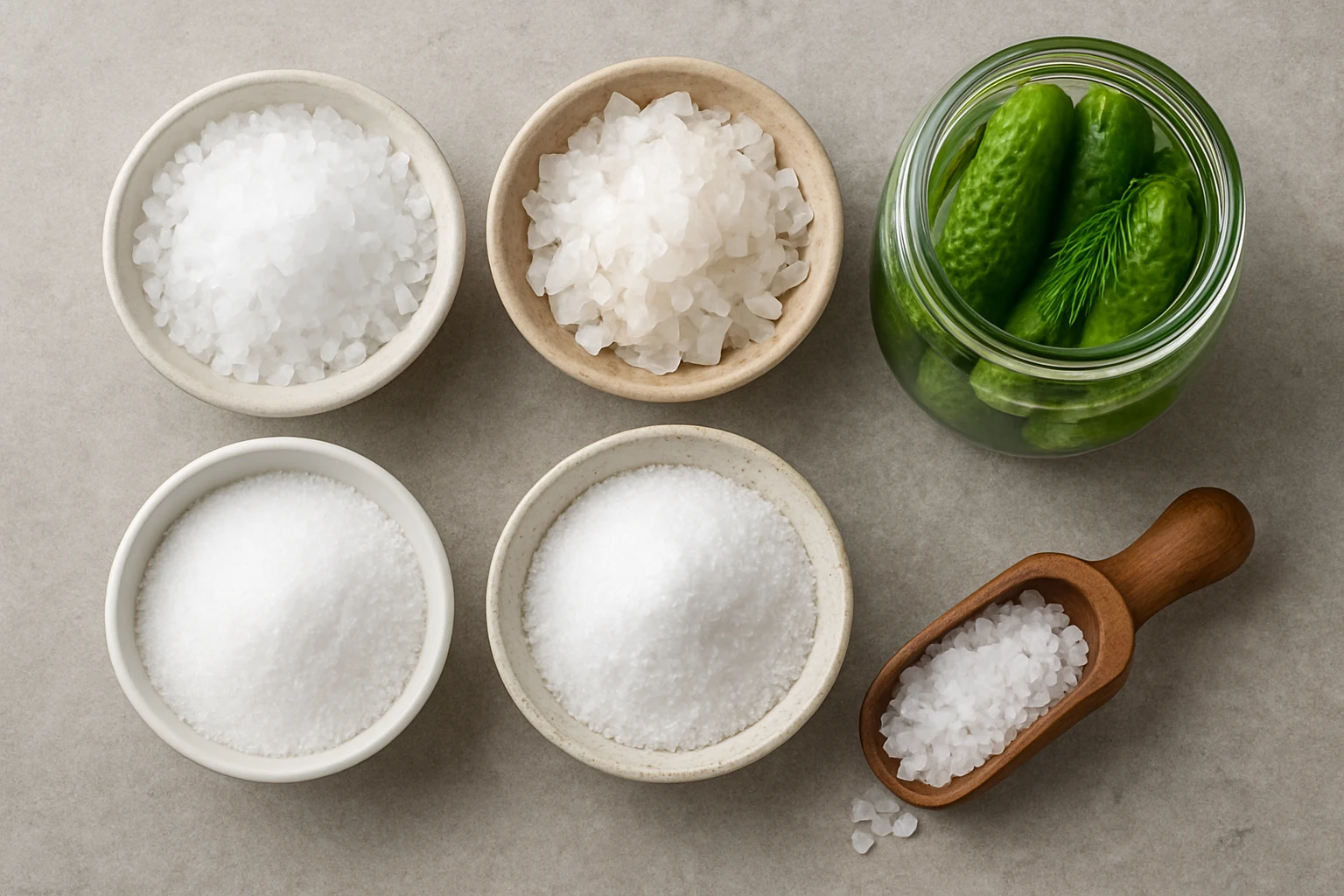
Types of Salt for Pickling: The Complete Guide to How Salt Choice Impacts Flavor, Texture & Fermentation
Introduction
This guide examines the role of salt in pickling, explains how various salt types influence flavor development, texture preservation and microbial activity, and provides actionable recommendations for home and commercial producers. Readers will learn the scientific basis of salt selection, compare popular options, and discover reliable products that support consistent results. The discussion balances theoretical insight with practical advice, ensuring that both novices and experienced artisans can improve their pickling outcomes.
The article is organized into clear sections, each building on foundational knowledge before presenting product suggestions. By the end of the guide, the reader will be equipped to choose the appropriate salt for any pickling project, avoid common pitfalls, and apply best‑practice techniques for optimal fermentation.
Background and Context
Salt performs three essential functions in pickling: it creates an environment that inhibits undesirable microorganisms, it draws water from vegetables to maintain crispness, and it contributes to the final taste profile. The concentration of sodium chloride, the presence of trace minerals, and the physical grain size all affect these functions.
Traditional pickling recipes often call for “pickling salt” or “canning salt,” which is pure sodium chloride without additives such as iodine or anti‑caking agents. Additives can discolor brine, alter flavor, or interfere with the fermentation microbiome. Modern producers may also consider mineral‑rich salts for subtle flavor enhancements, but they must understand how trace elements interact with lactic acid bacteria.
Fermentation relies on a delicate balance between salt concentration and bacterial activity. Too little salt permits spoilage organisms to dominate, while excessive salt can suppress the beneficial lactic acid bacteria, resulting in stalled fermentation or off‑flavors. The typical range for safe vegetable fermentation is 2‑3 % salt by weight, measured with a reliable kitchen scale.
Grain size influences how quickly salt dissolves in the brine. Fine grains dissolve rapidly, providing immediate osmotic pressure, whereas coarse grains release ions more slowly, which can be advantageous for long‑term storage or for brining large vegetable batches.
Understanding Salt Types for Pickling
Three major categories of salt are commonly used in pickling: pure pickling salt, mineral‑rich sea salts, and kosher salts. Each category possesses distinct characteristics that affect flavor, texture and fermentation dynamics.
- Pure Pickling Salt – This is 100 % sodium chloride, typically free of iodine and anti‑caking agents. It offers a neutral taste and predictable osmotic pressure, making it the safest choice for beginners.
- Mineral‑Rich Sea Salts – These salts retain trace minerals such as magnesium, calcium and potassium. The minerals can impart subtle flavor nuances and may influence the activity of certain bacterial strains.
- Kosher Salt – Kosher salt has larger, irregular crystals and is often free of additives. Its coarse texture provides a slower dissolution rate, which can be useful for large‑scale brines or for rimming jars.
When selecting a salt, the producer must consider the desired flavor profile, the size of the batch, and any dietary restrictions. For example, individuals who monitor sodium intake may prefer a salt with a lower density, allowing a smaller volume to achieve the same salinity.
Product Recommendations Aligned with Salt Categories
The following products exemplify the three salt categories and have been chosen for their reliability, high consumer ratings and suitability for pickling applications.
Redmond Real Fine Sea Salt
Redmond Real Fine Sea Salt is a mineral‑rich, unrefined sea salt harvested from an ancient Utah seabed. It contains trace minerals that contribute a subtly sweet flavor without bitterness. The product is available in a 16 oz pouch for $8.24 and holds a rating of 4.8 out of 5 stars from 22,477 reviews. Its fine grain size dissolves quickly, making it appropriate for brines that require rapid salinity establishment. The natural composition ensures no iodine or anti‑caking agents interfere with fermentation.
Redmond Real Fine Sea Salt offers the following key features:
- Unrefined, natural sea salt with trace minerals
- Subtly sweet flavor profile that enhances vegetable taste
- Fine grain for quick dissolution in brine
- Mined in the United States, supporting sustainable practices
Mrs. Wages Pickling & Canning Salt
Mrs. Wages Pickling & Canning Salt is a pure, additive‑free salt specifically formulated for canning and pickling. It is sold in a value pack of six 3‑pound resealable bags, priced at $17.97 for the pack, and carries a rating of 4.8 out of 5 stars from 655 reviews. The product contains no iodine, no artificial flavors, and no anti‑caking agents, ensuring crystal‑clear brine and consistent fermentation results.
Mrs. Wages Pickling Salt includes these advantages:
- High purity salt for sparkling clear brine
- Resealable bags preserve freshness between uses
- Ideal for large‑scale or multi‑batch pickling
- Kosher certified and free of artificial additives
Morton Coarse Kosher Salt
Morton Coarse Kosher Salt is a widely recognized kosher‑certified salt with a coarse grain structure. It is sold as a 4‑pack of 48 oz each for $15.28, and holds a rating of 4.8 out of 5 stars from 3,448 reviews. The coarse flakes adhere well to vegetables, allowing for even distribution during dry‑salt brining methods. While not a pure pickling salt, its lack of iodine and anti‑caking agents makes it suitable for many pickling processes.
Morton Coarse Kosher Salt provides these benefits:
- Large crystals dissolve gradually, supporting long‑term brines
- Versatile for rimming jars, dry‑salt packs and poultry brining
- Heritage brand with consistent quality since 1848
- Kosher certification for dietary compliance
Comparison and Selection Guide
The table below summarizes the principal attributes of each recommended salt, enabling the reader to match product characteristics with specific pickling requirements.
| Attribute | Redmond Real Fine Sea Salt | Mrs. Wages Pickling Salt | Morton Coarse Kosher Salt |
|---|---|---|---|
| Grain Size | Fine | Fine to medium | Coarse |
| Mineral Content | High (trace minerals) | None (pure NaCl) | Low (minimal trace minerals) |
| Additives | None | None | None |
| Iodine | Absent | Absent | Absent |
| Typical Use | Flavor‑enhanced brines, quick dissolve | Standard pickling, large batches | Dry‑salt packs, rimming, long‑term storage |
| Price per Pound | Approximately $0.52 | Approximately $0.30 | Approximately $0.32 |
| Customer Rating | 4.8/5 (22,477 reviews) | 4.8/5 (655 reviews) | 4.8/5 (3,448 reviews) |
When the goal is to impart a nuanced flavor while maintaining rapid brine formation, Redmond Real Fine Sea Salt is the optimal choice. For bulk production where cost efficiency and clarity of brine are paramount, Mrs. Wages Pickling Salt offers the best value. For applications that benefit from a slower release of salinity, such as dry‑salt packs for large cucumbers, Morton Coarse Kosher Salt is appropriate.
Best Practices & Tips for Successful Pickling
- Measure salt by weight rather than volume to achieve precise salinity; a digital scale reduces variability.
- Maintain a consistent temperature between 65 °F and 75 °F during primary fermentation; temperature fluctuations can alter bacterial activity.
- Use non‑iodized salt to prevent discoloration of brine and to avoid inhibition of lactic acid bacteria.
- Consider a two‑stage brining process: dissolve a portion of fine salt for initial osmotic pressure, then add coarse salt for gradual release during storage.
- Rinse vegetables briefly in cool water before salting to remove surface debris that could introduce unwanted microbes.
- Seal jars with air‑tight lids after the fermentation period to preserve crispness and prevent oxidation.
Frequently Asked Questions
1. Why is iodine problematic for pickling?
Iodine can react with the organic compounds in vegetables, leading to discoloration and off‑flavors. It may also interfere with the metabolic pathways of lactic acid bacteria, slowing fermentation.
2. Can I substitute kosher salt for pickling salt?
Yes, provided the kosher salt contains no additives. Because kosher salt crystals are larger, the weight required to achieve a 2‑3 % salinity is higher than for fine pickling salt; adjust measurements accordingly.
3. Does the mineral content of sea salt affect fermentation speed?
Trace minerals such as magnesium can enhance the activity of certain bacterial strains, potentially accelerating acid production. However, the effect is modest compared with the primary influence of overall salinity.
4. How long can a brine be stored before it loses effectiveness?
A properly sealed brine stored in a cool, dark place retains its salinity for several months. Over time, minor evaporation may concentrate the solution, so occasional checks are advisable.
5. Is it necessary to use a resealable bag for pickling salt?
Resealable packaging helps preserve dryness and prevents clumping, which ensures consistent measurement and reduces the risk of contamination.
6. What grain size is best for quick‑pickles?
Fine‑grained salts dissolve within minutes, making them ideal for quick‑pickles that require rapid flavor infusion.
7. Can I combine different salts in a single recipe?
Combining salts is possible, but it complicates calculations of salinity and mineral balance. For most home producers, selecting a single high‑quality salt simplifies the process.
Conclusion
The choice of salt exerts a profound influence on the flavor, texture and microbial stability of pickled foods. By understanding the distinctions between pure pickling salt, mineral‑rich sea salts and coarse kosher salts, the producer can tailor the brine to achieve desired outcomes. The recommended products—Redmond Real Fine Sea Salt, Mrs. Wages Pickling Salt and Morton Coarse Kosher Salt—represent reliable options that align with specific pickling strategies. Applying the best‑practice guidelines and selecting the appropriate salt will result in consistently crisp, flavorful and safely fermented vegetables.
Products Featured in This Guide
Redmond Real Fine Sea Salt
Price: $8.24 | Rating: 4.8/5 (22,477 reviews)
Featured because its fine grain and natural mineral profile provide quick dissolution and subtle sweetness, enhancing brine flavor without additives.
Mrs. Wages Pickling Salt
Price: $17.97 (value pack of six 3 lb bags) | Rating: 4.8/5 (655 reviews)
Featured because it is a pure, additive‑free salt designed for clear brine formation, ideal for large‑scale or commercial pickling operations.
Morton Coarse Kosher Salt
Price: $15.28 (4‑pack, 48 oz each) | Rating: 4.8/5 (3,448 reviews)
Featured because its coarse crystals dissolve slowly, making it suitable for dry‑salt packs, rimming, and long‑term fermentation where gradual salinity release is advantageous.