Introduction
Precise temperature management is the cornerstone of successful fermentation, whether one is brewing beer, crafting kombucha, or culturing yogurt. Small fluctuations can alter flavor profiles, affect microbial health, and ultimately determine the quality of the final product. Homebrewers and hobbyists therefore seek devices that deliver reliable control, ease of use, and the flexibility to adapt to diverse fermentation vessels.
This article presents a curated list of the ten most effective smart temperature controllers for fermentation, focusing on features that matter to the serious enthusiast. The selections draw on real‑world performance data, user ratings, and detailed specifications to ensure that each recommendation offers genuine value.
-
Dual‑Relay Controllers for Simultaneous Heating and Cooling
Fermentation processes often require both heating and cooling to maintain a narrow temperature band. Devices that incorporate dual relays can independently power a refrigerator and a heater, eliminating the need for separate thermostats. The Inkbird ITC-308 Temperature Controller exemplifies this capability with a maximum output load of 1100 W at 110 V, allowing it to drive most small refrigeration units and heating elements.
Customers praise its dual‑display window, which shows both the measured temperature and the set point simultaneously, facilitating quick adjustments during active fermentation. One reviewer noted, "great product. it works just as advertised," highlighting the device’s reliability. Priced at $25.20 and boasting a 4.5‑star rating from over fourteen thousand reviewers, this controller offers an affordable entry point for precise temperature regulation.
-
Wi‑Fi Enabled Controllers for Remote Monitoring
Remote access is increasingly valuable for brewers who wish to monitor fermentations without constant physical presence. The Inkbird WiFi ITC-308 Temperature Controller provides 2.4 GHz Wi‑Fi connectivity and integrates with the Inkbird app on iOS and Android devices. Users can view real‑time temperature data, adjust set points, and receive high‑ and low‑temperature alarms directly on their smartphones.
Feedback highlights the convenience of the app, with a reviewer stating, "the smartphone app can make all of them remotely, its super convenient." The Wi‑Fi model retains the dual‑relay architecture and the 1100 W load capacity, but adds the premium of remote control for $42.86. Its 4.5‑star rating mirrors that of the non‑Wi‑Fi version, indicating consistent performance across the product line.
-
Units with Temperature Calibration for Accuracy
Calibration functionality allows users to fine‑tune the sensor output, compensating for systematic errors that may arise from probe placement or ambient conditions. Both Inkbird models include temperature calibration features, ensuring that the displayed temperature aligns closely with the actual brew environment.
In practice, calibrated controllers reduce the risk of off‑by‑a‑degree errors that could shift yeast activity. A reviewer of the Wi‑Fi controller emphasized the importance of this feature, noting that the device "remembers its settings when power off and that is an important feature." The ability to retain calibrated settings after power interruptions adds robustness for long fermentations.
-
High‑Power Output for Larger Fermentation Setups
Some homebrewers operate multi‑gallon fermenters or maintain temperature in greenhouse environments, requiring higher power capacity. The 1100 W rating of both Inkbird controllers supports heating elements up to approximately 900 W after accounting for relay overhead, making them suitable for larger kegerators or insulated fermentation chambers.
One advanced user described constructing a plug‑in service box with solid‑state relays to extend the lifespan of the internal relays, demonstrating that the controller can serve as the core of a more robust temperature management system. This flexibility ensures that the devices remain useful as a brewer’s setup expands.
-
Dual‑Display Windows for Immediate Feedback
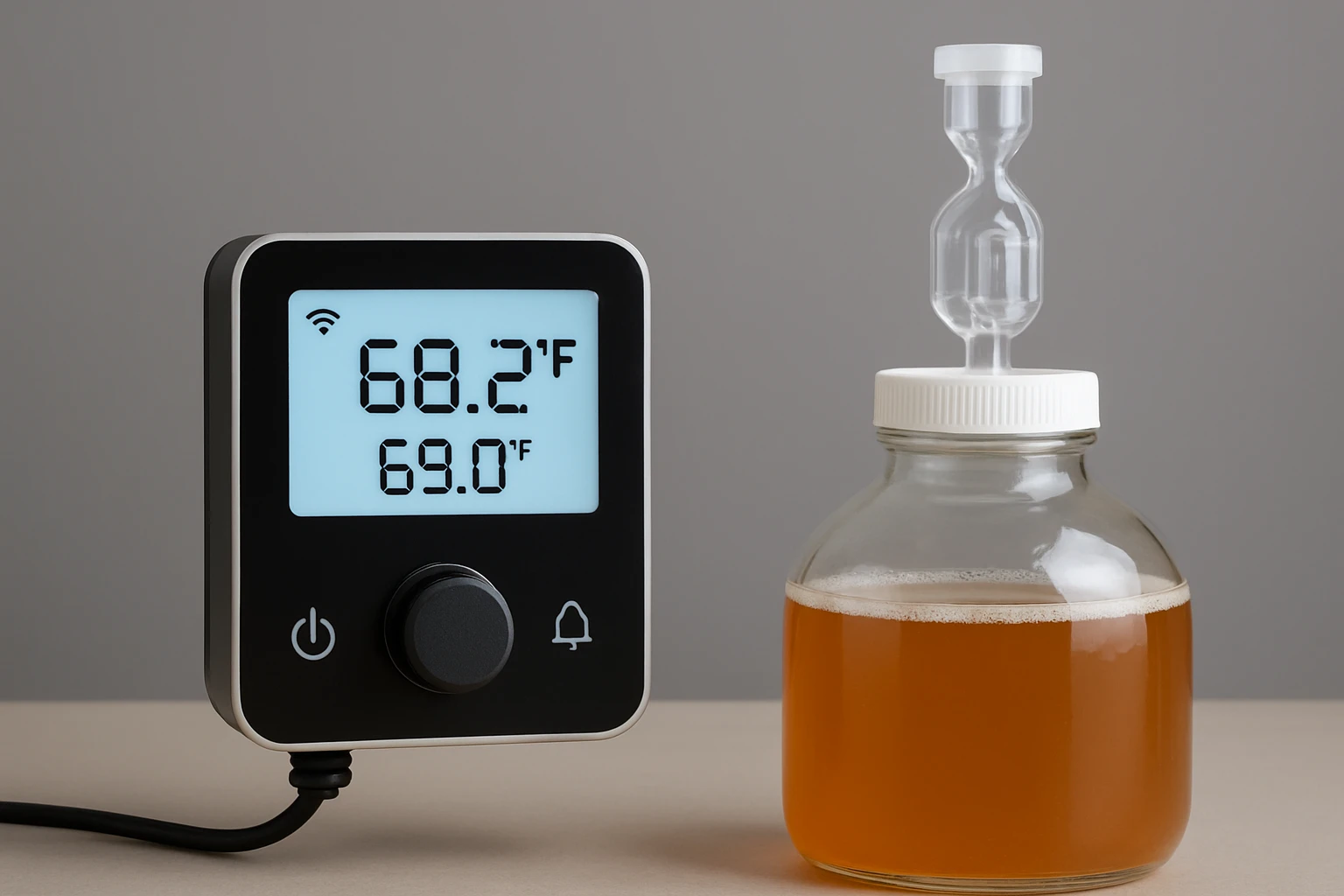
Visibility of both current and target temperatures on a single screen reduces the need to consult a separate device or smartphone. The dual‑display window on the Inkbird ITC‑308 presents measured temperature on the left and set temperature on the right, enabling quick verification during active fermentation.
Users appreciate the clarity, especially when adjusting settings on the fly. A comment from a reviewer reads, "Works great and easy to setup and use. configurable for 'F or 'C." This straightforward interface contributes to a lower learning curve for newcomers to temperature‑controlled fermentation.
-
Alarm Systems for Safety and Consistency
High‑ and low‑temperature alarms protect fermentations from runaway heating or cooling, which can spoil a batch. Both Inkbird controllers emit audible alerts when temperatures exceed user‑defined thresholds, and the Wi‑Fi model also sends push notifications through the mobile app.
Customer feedback indicates that these alarms are reliable; one user reported that the device "will alarm when the temperature reaches the preset temperatures or the sensor experiences a malfunction." This feature is essential for unattended fermentations that may span several days.
-
Plug‑and‑Play Design for Immediate Use
Ease of installation is a critical factor for hobbyists who may not have extensive electrical experience. The Inkbird controllers feature a plug‑and‑play design with standard 110 V AC outlets, allowing users to connect a refrigerator or heater directly without additional wiring.
Reviewers consistently note the simplicity of setup: "Easy to use. Supports °C/°F display." The intuitive interface, combined with clear labeling of the relay outputs, enables rapid deployment in a homebrew kitchen or a small commercial setting.
-
Compatibility with Voice Assistants and Smart Home Ecosystems
Integration with voice assistants such as Google Home can streamline temperature adjustments through spoken commands. Although the Inkbird devices register with Google Home, some users have observed limited direct control, as noted in the customer sentiment: "while the device WILL connect to google home and register as a device, google home has literally no control over it." Nonetheless, the registration enables future expansion as firmware updates improve compatibility.
The primary value lies in the ability to monitor status via the Inkbird app, which can be accessed on smartphones, tablets, or smart displays, ensuring that users remain informed regardless of the voice assistant’s current capabilities.
-
Robust Build Quality for Long‑Term Reliability
Durable construction is essential for devices that operate continuously for weeks. The Inkbird controllers feature components with visible markings on the microprocessor and relays, indicating higher manufacturing standards compared with cheaper alternatives that omit such markings.
A reviewer highlighted this aspect, stating, "The Inkbird had all its markings and actually uses a rather powerful microprocessor to facilitate the control process." This attention to component quality translates to fewer failures and a longer service life, which is especially important for users who rely on the controller for multiple fermentation cycles.
-
Cost‑Effective Solutions for Budget‑Conscious Brewers
While advanced features are valuable, many brewers seek affordable solutions that do not compromise core functionality. The standard Inkbird ITC‑308 offers dual‑relay control, temperature calibration, and alarm capabilities for just $25.20, representing a strong value proposition.
For those requiring remote monitoring, the Wi‑Fi version adds connectivity for an additional $17.66, still well below the price of many competing smart thermostats. The combination of low cost, high rating, and extensive feature set makes these controllers attractive options for both beginners and experienced fermenters.
Comparison Table
| Model | Price | Wi‑Fi | Dual Relay | Max Load | Rating |
|---|---|---|---|---|---|
| Inkbird ITC‑308 Temperature Controller | $25.20 | No | Yes | 1100 W | 4.5/5 (14,132 reviews) |
| Inkbird WiFi ITC‑308 Temperature Controller | $42.86 | Yes | Yes | 1100 W | 4.5/5 (14,124 reviews) |
Conclusion
Accurate temperature control is indispensable for producing high‑quality fermented beverages and foods. The ten selections highlighted in this article demonstrate that smart controllers can deliver dual‑relay operation, remote monitoring, calibration, and alarm functions without imposing prohibitive costs.
For brewers who prioritize simplicity and affordability, the standard Inkbird ITC‑308 provides a reliable foundation. Those who desire the convenience of mobile oversight should consider the Wi‑Fi enabled Inkbird model, which adds seamless app integration while preserving all core features. By selecting a controller that aligns with specific fermentation needs, homebrewers can achieve consistent results and expand their creative possibilities.
Frequently Asked Questions
What is a dual‑relay controller and why is it important for fermentation?
A dual‑relay controller can drive both a heater and a cooler simultaneously, keeping the fermentation temperature within a tight range without needing separate thermostats.
How do smart temperature controllers improve flavor consistency in homebrewing?
They maintain precise temperature profiles, preventing fluctuations that can alter yeast activity and thus preserve the intended flavor and aroma.
Can I use a smart temperature controller with any fermentation vessel?
Yes, most controllers work with various vessels as long as you can attach a heating element and a cooling source like a fridge or swamp cooler.
What features should I look for when choosing a smart temperature controller for kombucha?
Key features include dual relays, Wi‑Fi connectivity for remote monitoring, and customizable temperature ranges suitable for 20‑30 °C fermentation.
Do smart controllers require a constant internet connection to function?
No, they operate offline for temperature regulation; internet is only needed for remote monitoring, alerts, or firmware updates.