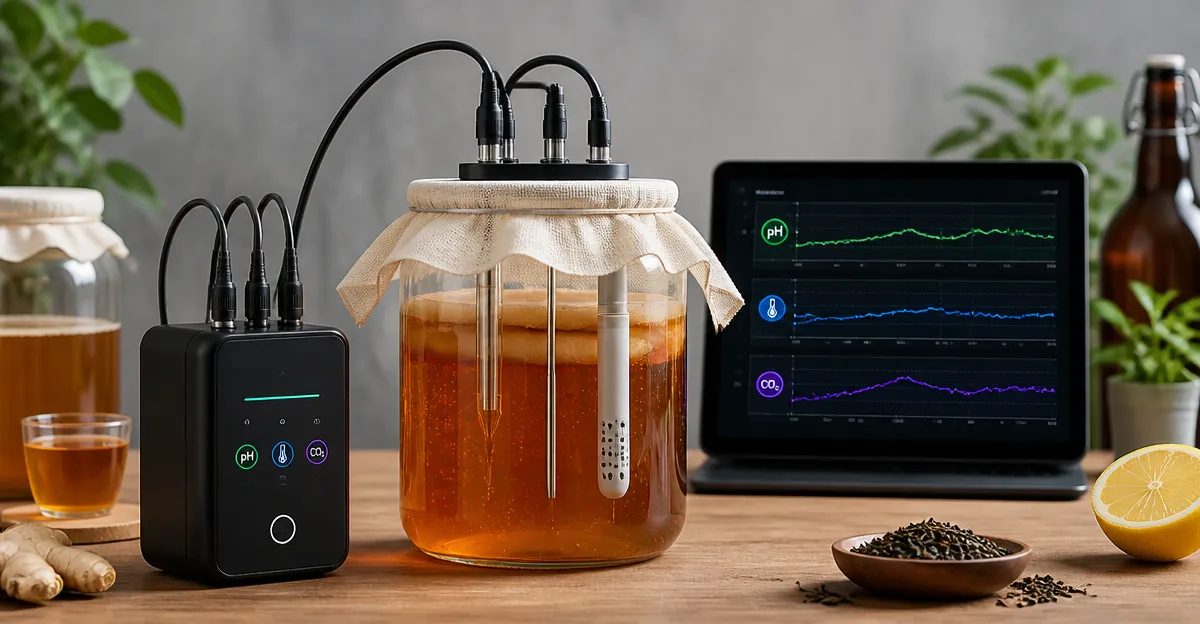
Complete Guide to Integrated Sensor Setup for Kombucha: Real-Time pH, Temperature & CO2 Monitoring
Introduction
Homebrewing kombucha has evolved from a hobbyist pastime to a scientifically informed practice. This guide explains how to integrate sensors that provide continuous pH, temperature and carbon dioxide data, enabling brewers to optimise flavour, safety and consistency. Readers will learn the underlying principles of fermentation, the hardware options that support real‑time monitoring, and how to select the most appropriate starter kits for reliable results.
The article balances theoretical background with actionable product recommendations, ensuring that both newcomers and experienced brewers gain practical value. By the end of the guide, one will be able to design a sensor‑driven brewing system, compare available kits, and apply best‑practice techniques that minimise waste and maximise quality.
Background/Context
Kombucha fermentation is driven by a symbiotic culture of bacteria and yeast (SCOBY) that converts sweet tea into a lightly effervescent, acidic beverage. The process is highly sensitive to three measurable variables: pH, temperature and carbon dioxide pressure. pH determines the acidity level that inhibits pathogenic microbes; temperature influences microbial metabolism rates; CO2 reflects the progress of secondary fermentation and carbonation.
Traditional brewing relies on periodic manual measurements using test strips and thermometers. While effective for small batches, this approach can miss rapid shifts that affect flavour or safety. Real‑time sensors address this limitation by providing continuous data streams that can be logged, visualised, and acted upon automatically.
Integrating sensors does not require advanced engineering skills. Modern microcontroller platforms, such as Arduino or Raspberry Pi, support plug‑and‑play modules for pH, temperature and CO2. These modules can be paired with wireless transmitters to deliver data to a smartphone or cloud dashboard, allowing brewers to monitor their brew from any location.
Key Sensor Concepts and Integration Strategies
pH Sensors
A pH sensor measures the concentration of hydrogen ions in the kombucha liquid. Accurate pH monitoring is essential because the target range (typically 2.5‑3.5) ensures a safe, tangy product. Electrochemical glass‑electrode probes provide high precision, while cheaper pH test strips offer quick spot checks. When selecting a sensor, consider calibration stability, temperature compensation and food‑grade materials.
Temperature Sensors
Temperature governs the metabolic activity of the SCOBY. Most kombucha strains thrive between 75°F and 85°F (24‑29°C). Digital thermistors or DS18B20 waterproof probes deliver reliable readings with minimal drift. Placement of the sensor in the centre of the brew jar avoids surface temperature bias.
CO2 Sensors
Carbon dioxide production indicates the progress of secondary fermentation, where flavours develop and natural carbonation forms. Non‑dispersive infrared (NDIR) sensors or galvanic CO2 cells can be used to monitor pressure inside sealed bottles. Data from CO2 sensors helps prevent over‑carbonation, which can cause bottle explosions.
Data Logging and Alerts
Connecting sensors to a microcontroller enables data logging to an SD card or cloud service. Open‑source platforms such as InfluxDB and Grafana provide visual dashboards that display trends over time. Configuring threshold‑based alerts (e.g., pH below 2.4) ensures that the brewer receives immediate notifications via email or push‑message.
Recommended Products for Sensor‑Enhanced Brewing
While the primary focus of this guide is sensor integration, a solid starter kit supplies the essential SCOBY, tea, sugar and basic measurement tools that complement electronic sensors. The following products have been selected for their inclusion of pH test strips, temperature gauges and high‑quality glassware, which serve as reliable baselines for sensor upgrades.
- Kombucha Shop Starter Kit – This all‑in‑one kit provides a 1‑gallon thick‑glass brew jar, USDA‑certified organic SCOBY, starter liquid, pH test strips, and an adhesive temperature gauge. The kit is rated 4.7/5 from 4,074 reviews and costs $54.99. Its comprehensive instruction booklet reduces the learning curve for sensor calibration.
- Urban Kitchen Kombucha Starter Kit – Featuring an organic SCOBY, reusable cotton cover, and a built‑in temperature gauge, this kit emphasizes cost‑effectiveness at $39.99. With a 4.6/5 rating from 812 reviews, it includes high‑quality loose‑leaf tea that yields a clear baseline for pH testing.
- Fermentaholics SCOBY Starter Tea – This product supplies 1.5 cups of mature starter tea and a certified organic SCOBY for $13.89. Its 4.5/5 rating from 8,454 reviews makes it an economical choice for brewers who already own measurement hardware.
- Fermentaholics Essentials Kit – A budget‑friendly option at $36.99, the kit includes a 1‑gallon glass jar, breathable muslin cover, pH strips and an adhesive thermometer. Reviewers rate it 4.6/5 based on 802 reviews, noting its simplicity for sensor retrofitting.
- Kombucha Starter Kit with Glass Jar – This 1.3‑gallon jar features a stainless‑steel spigot, pH test strips, temperature strip and a funnel with filters. Priced at $37.99 and rated 3.9/5 from 15 reviews, it provides a larger volume for continuous‑brew experiments.
Comparison/Selection Guide
| Product | Price | Key Included Sensors | Rating | Best For |
|---|---|---|---|---|
| Kombucha Shop Starter Kit | $54.99 | pH strips, adhesive temperature gauge, 1‑gal glass jar | 4.7/5 | Comprehensive beginner kit with premium glass |
| Urban Kitchen Kombucha Starter Kit | $39.99 | pH strips, temperature gauge, reusable cotton cover | 4.6/5 | Cost‑effective starter with organic ingredients |
| Fermentaholics SCOBY Starter Tea | $13.89 | Starter tea (pH pre‑adjusted), organic SCOBY | 4.5/5 | Budget‑friendly culture source |
| Fermentaholics Essentials Kit | $36.99 | pH strips, adhesive thermometer, 1‑gal jar | 4.6/5 | Minimalist kit for sensor retrofits |
| Kombucha Starter Kit with Glass Jar | $37.99 | pH strips, temperature strip, spigot, funnel | 3.9/5 | Larger volume brewing and continuous‑brew setups |
Best Practices & Tips for Sensor‑Driven Brewing
- Calibrate pH probes before each brew using standard buffer solutions (pH 4.0 and pH 7.0). Record the calibration curve in the data log.
- Place the temperature sensor at the centre of the liquid, avoiding direct contact with the jar walls, to obtain an accurate reading of the brew’s core temperature.
- When using CO2 sensors, ensure the bottle caps are equipped with pressure‑release valves to prevent over‑pressurisation.
- Maintain a sterile environment for all sensor probes. Rinse with a diluted bleach solution (1 % sodium hypochlorite) and rinse thoroughly with filtered water before insertion.
- Integrate alerts that trigger when pH drops below 2.5 or rises above 3.5, and when temperature deviates more than ±2 °F from the target range.
- Document each batch’s sensor data alongside flavour notes. Over time, this dataset reveals correlations that guide recipe adjustments.
- Leverage the included pH strips and temperature gauges from the starter kits as reference points while validating electronic sensor accuracy.
Frequently Asked Questions
- How often should pH be measured during primary fermentation? Continuous electronic monitoring is ideal, but at a minimum check pH daily using strips until it stabilises within 2.5‑3.5.
- Can I use a single temperature probe for multiple jars? Yes, provided the probe is moved between jars after each reading and the system logs timestamps to differentiate data.
- What is the safest way to vent CO2 from sealed bottles? Use swing‑top bottles with built‑in pressure release or install a one‑way valve that releases excess gas once a preset pressure is reached.
- Do I need a separate power source for the sensors? Most microcontroller boards operate from a 5 V USB power bank, allowing portable, off‑grid brewing setups.
- Will the sensor data affect the flavour of the kombucha? Sensors themselves are inert; however, maintaining optimal pH and temperature based on sensor feedback directly improves flavour consistency.
- How long can I reuse the pH probe? With proper cleaning and storage in a protective solution, a quality glass‑electrode probe can last several years.
- Is it necessary to purchase a kit if I already have a SCOBY? Not necessarily, but kits that include calibrated pH strips and temperature gauges provide a reliable baseline for sensor validation.
Conclusion
Integrating real‑time pH, temperature and CO2 monitoring transforms kombucha brewing from an art into a data‑driven science. By selecting a starter kit that supplies accurate baseline tools, calibrating sensors meticulously, and employing automated alerts, brewers can achieve consistent flavour, safety and carbonation across batches. The combination of electronic sensors with high‑quality kits such as the Kombucha Shop Starter Kit or the Urban Kitchen Kombucha Starter Kit offers a robust foundation for both novices and seasoned fermenters.
Products Featured in This Guide
Kombucha Shop Starter Kit
Price: $54.99 | Rating: 4.7/5 (4,074 reviews)
Featured for its comprehensive inclusion of a 1‑gallon glass jar, organic SCOBY, starter liquid, pH test strips and an adhesive temperature gauge, providing an ideal baseline for sensor calibration.
Urban Kitchen Kombucha Starter Kit
Price: $39.99 | Rating: 4.6/5 (812 reviews)
Featured for its organic SCOBY, reusable cotton cover and built‑in temperature gauge, offering a cost‑effective entry point for integrating electronic sensors.
Fermentaholics SCOBY Starter Tea
Price: $13.89 | Rating: 4.5/5 (8,454 reviews)
Featured for its mature starter tea and organic SCOBY, delivering a ready‑to‑use culture that pairs well with external pH and temperature sensors.
Fermentaholics Essentials Kit
Price: $36.99 | Rating: 4.6/5 (802 reviews)
Featured for its stripped‑down configuration that includes a 1‑gallon glass jar, pH strips and an adhesive thermometer, making it ideal for sensor retrofitting.
Kombucha Starter Kit with Glass Jar
Price: $37.99 | Rating: 3.9/5 (15 reviews)
Featured for its 1.3‑gallon jar equipped with a stainless‑steel spigot, pH strips and temperature strip, supporting larger batch experiments and continuous‑brew configurations.