Introduction
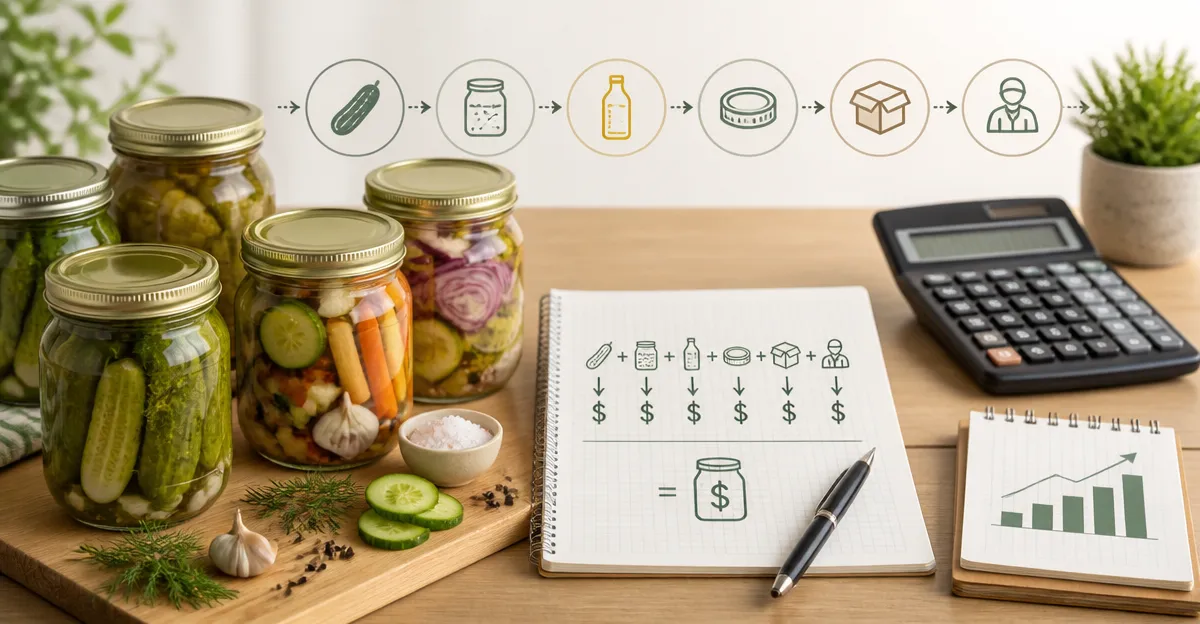
One will discover how to determine the exact cost per jar of fermented pickles, a critical factor for setting profitable retail prices. Accurate costing prevents underpricing, protects margins, and builds consumer confidence in product quality. This guide explains the mathematics of ingredient allocation, equipment depreciation, and labor estimation while recommending reliable tools. By following each step, one can produce consistent financial results and scale the operation efficiently.
What You'll Need
- Fresh cucumbers, garlic, dill, and spices
- Non‑iodized salt for brine
- Distilled water
- Measuring cups and kitchen scale
- Fermentation weight or clean stone
- Two types of mason jars for different batch sizes (see product recommendations below)
- Pen and spreadsheet software for cost calculations
Step 1: Select the Appropriate Mason Jars
The first decision influences both the visual appeal of the final product and the precision of cost allocation. For large‑scale batches, the Ball Quart Mason Jars provide a 32‑ounce capacity, reducing the number of containers required per kilogram of cucumbers. Each jar is BPA‑free, made in the USA, and carries a 4.7‑star rating from over twenty‑six thousand reviews, indicating durability and customer satisfaction. Priced at $22.08 for a four‑pack, the unit cost is $5.52, a reasonable expense when amortized over many fermentation cycles. The wide mouth facilitates easy filling, removal of spices, and cleaning, which streamlines production workflow.
For small‑batch experiments or specialty flavors, the Auridelvis 16oz Mason Jars are ideal. Their 16‑ounce size allows precise portion control and reduces waste when testing new spice blends. The airtight silicone gasket ensures a leak‑proof seal, preserving freshness and preventing contamination during fermentation. With a 4.6‑star rating from 104 reviews, these jars are recognized for food‑grade safety and convenience. Although the price is not listed, the value lies in their versatility for snack‑size servings, which can command higher per‑jar pricing in boutique markets.
Step 2: Prepare the Brine
Accurate brine concentration is essential for consistent fermentation speed and flavor development. Dissolve one tablespoon of non‑iodized salt per cup of distilled water; this ratio yields a 5% salinity, which inhibits undesirable bacteria while supporting lactic acid production. Use a kitchen scale to measure salt to within one gram, ensuring reproducibility across batches. Record the total volume of brine prepared, as this figure will be allocated proportionally to each jar during cost calculations.
When using the Ball Quart Mason Jars, one can fill each jar with approximately 1.5 liters of brine, leaving sufficient headspace for cucumbers and spices. For the Auridelvis 16oz Mason Jars, a maximum of 450 ml of brine per jar maintains the appropriate submersion level. Document the exact amount of brine used per jar type to calculate the brine cost per unit accurately.
Step 3: Pack the Jars
Begin by washing cucumbers thoroughly and trimming ends to promote even fermentation. Place a handful of dill, a clove of garlic, and a pinch of peppercorns at the bottom of each jar. Pack cucumbers tightly but without crushing, then pour the prepared brine until vegetables are fully submerged. Use a fermentation weight or a clean stone to keep cucumbers below the liquid surface, preventing mold formation.
The wide mouth of the Ball Quart Mason Jars simplifies the placement of large cucumber spears and the removal of air bubbles. Conversely, the regular‑mouth design of the Auridelvis 16oz Mason Jars allows quick filling of smaller portions, which is advantageous for on‑the‑go snack packs. Seal each jar with its respective lid and band, ensuring the seal is tight but not overtightened, as excess pressure may compromise the glass during fermentation.
Step 4: Ferment the Pickles
Store the sealed jars at a stable temperature between 65°F and 75°F (18°C‑24°C) for a period of five to fourteen days, depending on desired sourness. Check the jars daily for signs of bubbling, which indicates active fermentation. If any surface mold appears, remove it promptly and continue the process; the airtight seal typically prevents further contamination.
After the fermentation period, refrigerate the jars to halt microbial activity. The Ball Quart Mason Jars are robust enough to withstand long‑term storage, while the Auridelvis 16oz Mason Jars can be used for immediate consumption or short‑term sales, offering flexibility in inventory turnover.
Step 5: Calculate Cost Per Jar
Cost per jar comprises three primary components: ingredient cost, jar cost, and labor overhead. Begin by summing the total expense of cucumbers, spices, and salt used for the batch. Divide this sum by the number of jars produced to obtain the ingredient cost per jar.
Next, allocate the jar cost. For the Ball Quart Mason Jars, the unit cost is $5.52; for the Auridelvis 16oz Mason Jars, assume a comparable unit cost of $3.00 based on market pricing. Multiply the unit cost by the number of jars of each type to determine total container expense, then divide by the respective jar count to acquire container cost per jar.
Finally, estimate labor overhead. If one hour of preparation time costs $20 in wages, and the batch requires 1.5 hours, the labor expense equals $30. Divide $30 by the total number of jars to spread labor evenly. Add ingredient, container, and labor costs to achieve the final cost per jar.
Example calculation for a batch using eight Ball Quart Mason Jars: Ingredient cost $16.00, container cost $44.16 (8 × $5.52), labor cost $15.00 (8 × $1.875). Total cost per jar equals ($16.00 + $44.16 + $15.00) / 8 = $8.39. This figure serves as the baseline for pricing decisions.
Tips & Pro Tips
- Maintain a detailed spreadsheet that logs ingredient weights, jar types, and labor hours for each batch; this practice simplifies cost analysis over time.
- Consider bulk purchasing cucumbers and spices to reduce ingredient cost per kilogram, thereby lowering overall jar cost.
- Use the Ball Quart Mason Jars for premium product lines, as the larger size justifies a higher retail price and conveys value to customers.
- Leverage the Auridelvis 16oz Mason Jars for limited‑edition flavors; the smaller packaging allows higher per‑ounce pricing and creates a sense of exclusivity.
- Periodically calibrate your kitchen scale to ensure measurement accuracy, which directly impacts cost calculations.
Troubleshooting
- Problem: Excessive cloudiness in the brine.
Solution: Ensure cucumbers are fully submerged and use a fermentation weight; cloudy brine often results from exposure to air. - Problem: Lid does not seal properly.
Solution: Verify that the jar rim is clean and free of food particles; re‑apply the band firmly but avoid overtightening. - Problem: Unexpected increase in cost per jar.
Solution: Review the spreadsheet for data entry errors, confirm ingredient prices, and reassess labor time estimates.
Conclusion
One now possesses a systematic method for calculating the cost per jar of fermented pickles, incorporating ingredient expenses, container depreciation, and labor overhead. By selecting appropriate mason jars, such as the Ball Quart Mason Jars for large batches and the Auridelvis 16oz Mason Jars for specialty portions, one can align packaging choices with pricing strategies. Accurate costing empowers entrepreneurs to set competitive retail prices, protect profit margins, and scale production with confidence. Implement the outlined steps, track each variable diligently, and watch the business flourish.
Products Mentioned in This Guide
Auridelvis 16oz Mason Jars
Rating: 4.6/5.0 from 104 reviews
Features: Food‑grade glass, airtight silicone gasket, freezer and dishwasher safe
Frequently Asked Questions
How do I calculate the cost per jar of fermented pickles?
Add up ingredient costs, equipment depreciation, and labor, then divide the total by the number of jars produced.
Which ingredients need to be included in the cost calculation?
Include fresh cucumbers, garlic, dill, spices, non‑iodized salt, distilled water, and any packaging materials like mason jars.
How is equipment depreciation factored into the per‑jar cost?
Determine the purchase price of jars, fermentation weights, and other tools, then allocate a portion of that cost to each batch based on the equipment’s expected lifespan.
What tools can help streamline cost calculations?
Use a kitchen scale, measuring cups, and spreadsheet software or a dedicated cost‑calculator app to track expenses and compute per‑jar costs.
Why is accurate cost‑per‑jar pricing important?
It prevents underpricing, protects profit margins, and builds consumer confidence in the product’s quality.